
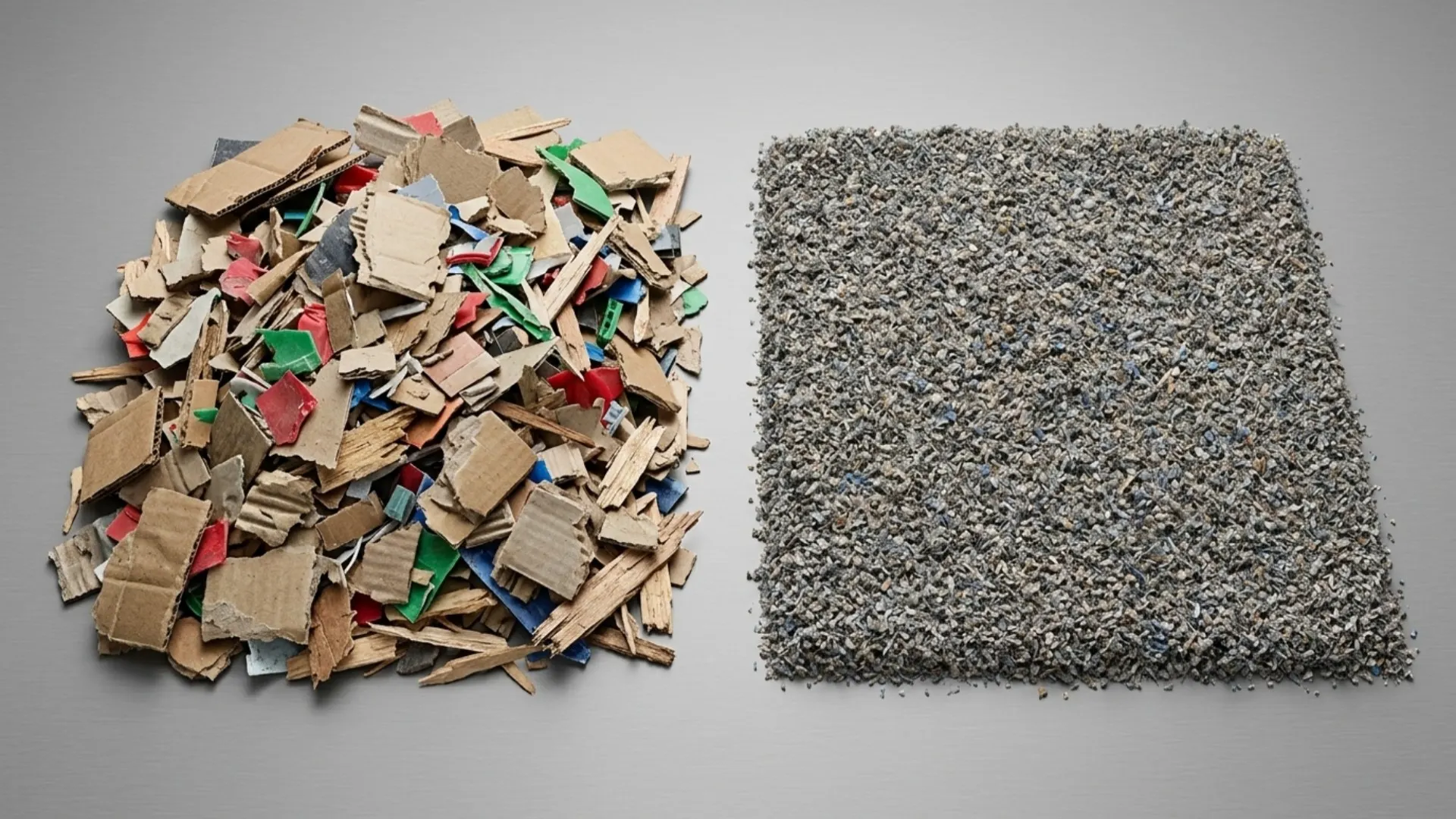
Refuse-derived fuel (RDF) production depends on one factor more than any other: consistent output size. Cement plants and waste-to-energy (WtE) facilities cannot use RDF that arrives as an uneven mix of large chunks and fines. It can clog feeding systems, burn unevenly, and force operators to use additional fossil fuel. Secondary shredding is the stage that solves this problem, and understanding how it works is important for any plant evaluating or upgrading its RDF Processing Plant.
Why Primary Shredding Alone Is Not Enough
Every RDF processing line starts with primary shredding, which breaks down bulky municipal solid waste (MSW), commercial waste, or pre-sorted combustible fractions into manageable sizes, typically in the range of 100 to 300 mm. This step is necessary to reduce volume and prepare material for downstream sorting equipment such as trommels, ballistic separators, and air classifiers. However, primary shredded output is far from fuel-ready. It still contains a wide mix of sizes, irregular shapes, and material types, including plastics, textiles, paper, wood, and rubber, all behaving differently under mechanical stress. Feeding this material directly into a cement kiln’s calciner or a WtE boiler can cause uneven combustion, higher particulate emissions, and unpredictable calorific output. Cement plants co-processing RDF as an alternative fuel and raw material (AFR) source have strict material size requirements. For most commercial cement plant precalciners, the target RDF/SRF size is typically under 30 to 80 mm range, while main burner injection requires much finer sizing, often below 10 to 20 mm depending on pneumatic conveying requirements.What Secondary Shredding Actually Does
Secondary shredding is the refinement stage. It takes primary-shredded, pre-sorted RDF fractions and reduces them further to a uniform, kiln-ready or boiler-ready size. This is not simply “shredding again.” Secondary shredders are designed differently from primary units, with tighter rotor and screen configurations, higher rotational speeds in some designs, and cutting geometries optimized for fibrous and mixed-density waste rather than bulky, high-torque loads. The output matters on three critical fronts:- Combustion efficiency: Uniform size means more consistent surface area, which supports predictable ignition and burn rates. This directly affects the calorific value delivered in the kiln and reduces the risk of incomplete combustion.
- Feed system reliability: Cement kiln feeding systems, including pneumatic conveying and gravimetric dosing systems, are designed for specific dimensions. Oversized fragments can cause blockages and unplanned downtime. WtE grate and fluidized bed systems face similar operational challenges.
- Emissions compliance: Inconsistent size can lead to incomplete combustion, increasing CO and particulate emissions. Plants operating under Central Pollution Control Board (CPCB) norms or state pollution control board conditions for AFR co-processing need combustion behaviour that remains within a predictable range, and that starts with consistent feedstock.
The Technical Demands on Secondary Shredders
RDF feedstock in Indian plants is rarely homogeneous. It typically includes a mix of plastic films, PET and HDPE fragments, textiles, paper and cardboard residue, rubber pieces, and occasionally wood or composite material that survives upstream sorting. This variation puts specific demands on secondary shredder design:- Screen sizing: Needs to be adjustable so plants can tune output size to match cement kiln or boiler specifications without replacing the entire cutting chamber.
- Rotor and blade wear resistance: This is important because fibrous plastics and rubber can cause significant wear during continuous operation. The material and hardness of the blades directly affect their service life, maintenance intervals, and overall cost of ownership.
- Throughput stability: Performance under changing feedstock composition is critical. A shredder that performs well on clean plastic waste but chokes on mixed, textile-heavy loads can create a bottleneck for the entire plant.
- Low fines generation: Often overlooked but important. Excessive fines increase dust handling requirements and can lower the effective calorific value of the batch if they contain non-combustible contaminants such as grit or glass.