
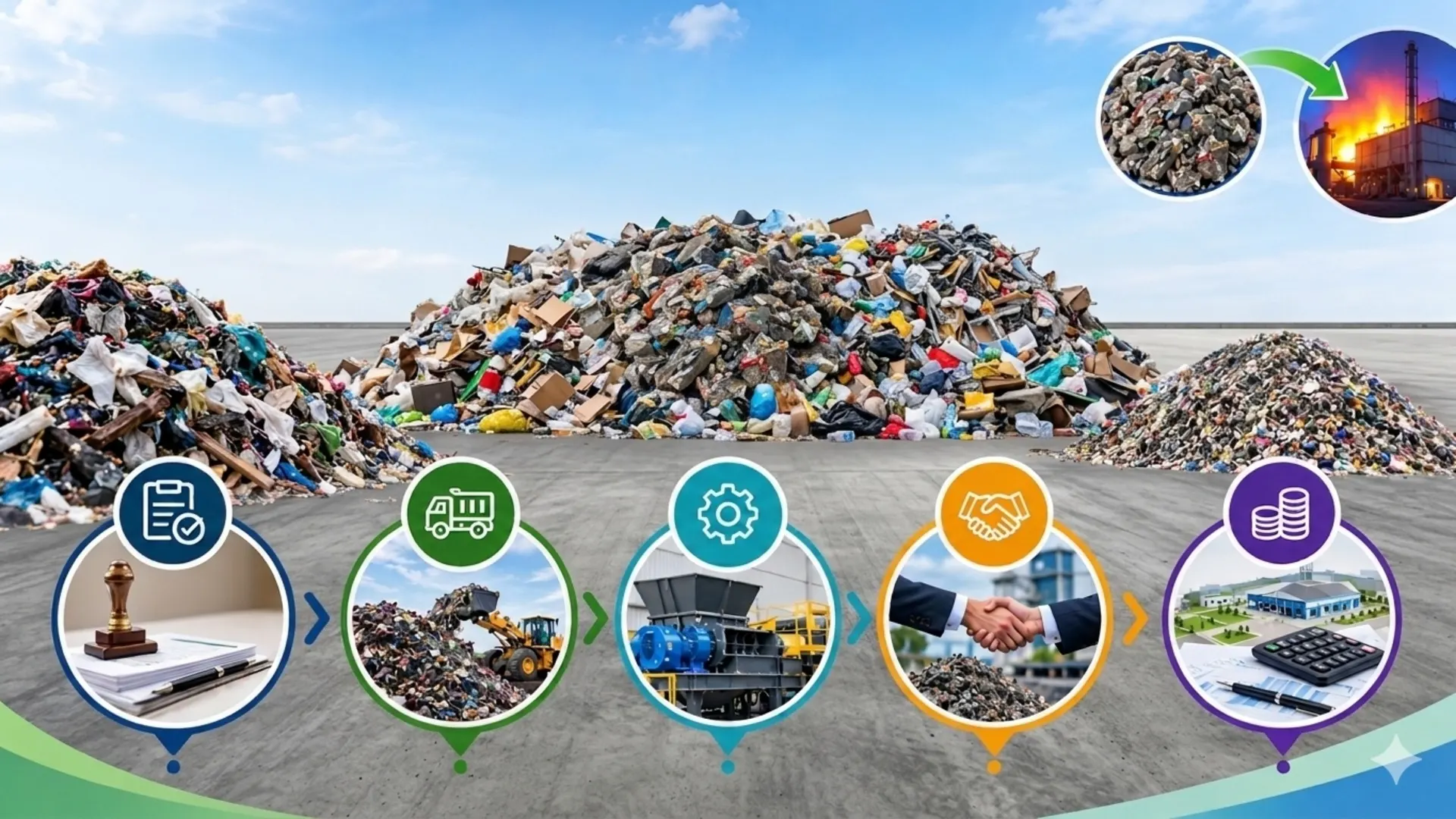
Setting up a Solid Recovered Fuel (SRF) plant in India requires careful planning, a steady supply of waste, the right machinery, and reliable buyers. Because SRF requires high-quality standards (strict limits on moisture, ash, chlorine, and heavy metals) to be sold to cement kilns or power plants, meticulous planning is essential.
Here is a simple checklist to help plan and set up an SRF plant successfully in India:
Statutory Approvals and Regulatory Compliance:
Before starting construction, it is important to get the required government approvals and follow environmental rules.
- Land Use and Zoning: Make sure the land is approved for industrial use. Obtain a Non-Agricultural (NA) certificate from the relevant authorities, wherever required.
- Pollution Control Approvals: Apply for Consent to Establish (CTE) before construction and Consent to Operate (CTO) before starting operations from the respective State Pollution Control Board (SPCB).
- Environmental Clearance: Check whether the plant needs Environmental Clearance (EC) based on its size, location, and applicable regulations.
- Solid Waste Management Rules: Follow India’s Solid Waste Management Rules and applicable Extended Producer Responsibility (EPR) requirements.
- Local Permissions: Obtain the necessary approvals from the municipal corporation or gram panchayat for waste handling, vehicle movement, and other local requirements.
- Fire and Safety Approvals: Arrange the required fire safety approvals. Dry waste and SRF can catch fire easily, so proper fire prevention systems are essential.
Secure a Regular Supply of Waste:
An SRF plant needs a steady supply of suitable waste to run smoothly. Without enough raw material, production can slow down and operating costs can increase.
- Long-Term Agreements: Sign agreements with municipal bodies, commercial centres, and industrial areas to ensure a regular supply of municipal solid waste (MSW) and other suitable waste.
- Waste Quality Testing: Study the incoming waste to understand its moisture content and the amount of plastic, organic waste, metals, stones, and other materials it contains. This helps determine the right processing method.
- Tipping Fees: Discuss tipping fees with waste suppliers or municipal bodies. These fees can help cover the cost of collecting, sorting, and processing waste.
Choose the Right Technology and Machinery:
SRF requires better quality control than Refuse-Derived Fuel (RDF). The plant must remove unwanted materials and process the waste to meet the buyer’s fuel requirements. The right machinery plays a major role in achieving this.
- Pre-Sorting and Shredding: Use heavy-duty primary shredder & secondary /fine shredder that can handle Indian municipal waste, including mixed waste with high moisture content and unwanted materials.
- Screening and Separation: Install trommel screens, air separators, and magnetic or eddy-current separators to remove stones, glass, metals, and other unwanted materials.
- Drying Systems: Indian waste often contains high moisture levels. Depending on the waste and process, use suitable drying systems to reduce moisture to the level required by the buyer. Some plants may target moisture levels below 15%.
- Optical Sorting: Consider near-infrared (NIR) sorting systems when better control over plastic types, especially PVC, is needed to meet chlorine limits set by buyers.
- Pellets, Briquettes or Fluff: Decide whether to produce loose SRF fluff, pellets, or briquettes based on the buyer’s requirements, transport costs, and fuel-feeding system.
Confirm Buyers Before Starting Production:
A plant needs reliable buyers to generate regular revenue. Cement plants are important users of SRF in India, along with other industries that can use suitable waste-derived fuels.
- Understand Quality Requirements: Discuss the required calorific value, moisture, ash, and chlorine levels with potential buyers. Some cement kilns may look for a net calorific value of around 3,500–4,500 kcal/kg, depending on their requirements.
- Sign Long-Term Supply Agreements: Wherever possible, secure fuel supply agreements with cement plants, captive power plants, or industrial boilers before commissioning the facility.
- Plan Storage and Transportation: Provide covered, dry storage for finished SRF. Plan regular dispatch and suitable transportation to prevent moisture from increasing during storage and delivery.
Check Financial and Infrastructure Requirements:
A successful SRF plant needs more than the right machinery. It must also have a realistic budget, reliable utilities, and a plan to manage daily operating costs.
- Capital and Operating Costs: Calculate the cost of land, machinery, installation, labour, maintenance, and transportation. Indian waste often contains dust and sand, which can wear down shredder blades and conveyor parts faster.
- Power and Water Supply: Arrange a reliable industrial power connection for machinery. Ensure sufficient water is available for dust control and firefighting.
- Maintenance Planning: Include regular inspection, blade replacement, spare parts, and servicing costs in the operating budget to avoid unexpected breakdowns.
- Explore EPR Opportunities: Check whether processing eligible plastic waste can generate additional revenue through EPR certificates or other authorised mechanisms. Confirm the applicable rules and eligibility before including this income in the project plan.
Why Choose Fornnax for Your SRF Plant?
Every cement and Waste-to-Energy (WtE) facility operates under distinct operational requirements. To meet these precise demands, Fornnax delivers both standalone SRF shredders and fully customized, turn-key processing plants tailored to your input material, desired output particle size, capacity targets, and separation needs.
A successful SRF production line requires a seamless integration of size reduction, material separation, and high-uptime plant performance. Fornnax’s engineered SRF solutions deliver continuous capacities ranging from 200 to 1,000 tonnes per day, effectively converting Municipal Solid Waste (MSW), Commercial & Industrial Waste (C&I), Construction & Demolition Waste (C&D), and bulky waste into high-quality alternative fuels.
Key Advantages:
- Tailored Processing: Engineered around specific input feedstocks to achieve exact output particle size and purity requirements.
- Effective Material Separation: Efficiently removes non-combustibles, heavy fractions, and metals to protect downstream equipment and ensure optimal fuel specs for cement kilns and power plants.
- Automated Control: Equipped with PLC-based control systems for smooth, reliable throughput, minimum downtime, and enhanced operating safety.
- Sustainability Impact: Replaces conventional coal and fossil fuels with reliable, high-calorific alternative fuel, driving circular economy goals.