
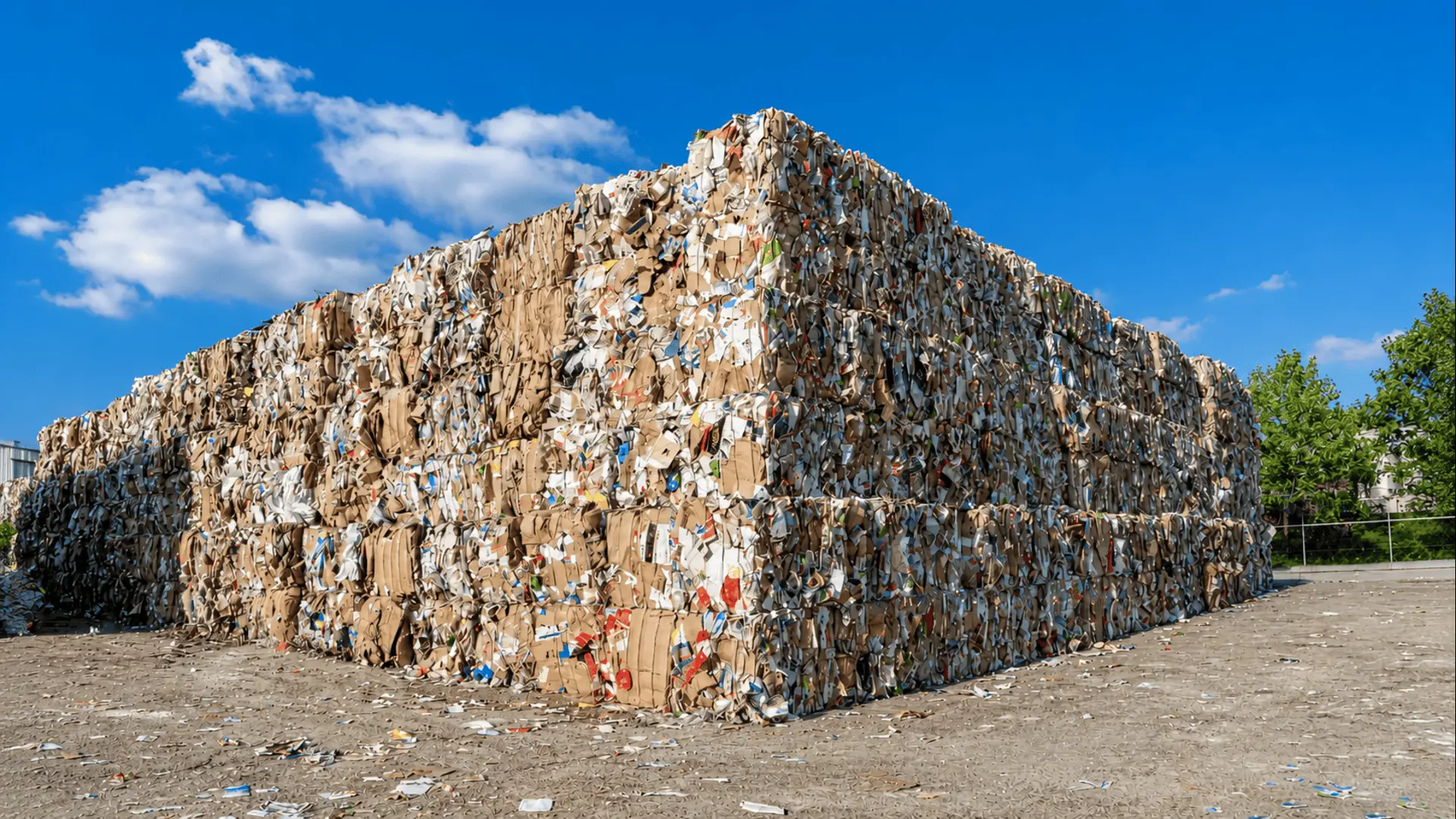
The Middle East and North Africa face a mounting waste crisis. According to the World Bank 2026 report, the region generates over 155 million tons of municipal solid waste every year. Without decisive action, that volume will nearly double to 294 million tons by 2050.
For governments or recyclers planning a new municipal solid waste processing plant and for operators upgrading existing lines, these numbers demand attention because the challenge is not just volume; it is what happens after collection.
The Real Gap: Collection vs Recovery
MENA cities collect waste well. Nearly 80 percent of municipal waste is collected on average, and high-income countries reach 95 percent. Yet only 10 percent of waste is recycled, reused, or composted. Two-thirds of all generated waste is improperly managed. It ends up uncollected, openly dumped, burned, or untracked.
That gap costs the region US$7.2 billion each year in environmental damage. Poor waste management pollutes air, soil, and water. It threatens public health and tourism. The Mediterranean is among the world’s most plastic-polluted seas, and MENA has the highest per-capita footprint of plastics entering the seas. Beach litter can substantially erode visitor numbers and revenue from tourism.
Three Forces Driving Waste Growth in GCC, Egypt, and Morocco
Population growth, rapid urbanization, and rising incomes push volumes higher. MENA already produces 0.9 kg of waste per capita per day. That is above the global average of 0.79 kg and higher than East Asia and the Pacific, South Asia, or Sub-Saharan Africa.
Food waste complicates the mix. Around 19% of available food in the region is wasted or lost, costing over US$60 billion annually. Wasted food contributes 11% of all municipal waste. Organic material makes up 57% of municipal waste in MENA. Any solid waste recycling plant must handle this wet, heavy fraction effectively.
How MENA’s Recovery Rates Compare
High-income MENA countries recycle 8.2 percent of their waste. The global average for high-income countries is 29 percent. Middle-income countries in the region recycle 7.7 percent. The infrastructure to sort, reduce, and recover materials at scale remains limited.
Where a Municipal Solid Waste Shredder Fits in the Chain
You cannot sort what you cannot feed. Bulky, mixed municipal waste needs size reduction before optical sorters, trommels, or composting systems work. A municipal solid waste shredder performs that first critical step. It breaks down furniture, white goods, green waste, and mixed bags into a consistent, processable fraction.
Primary shredders handle raw, unsorted loads. They take the unpredictable input from collection trucks and deliver a uniform particle size. Secondary shredders then refine the output for RDF production, composting, or material recovery. Without this stage, downstream equipment jams, recovery rates drop, and OPEX climbs.
Landfilling is still the predominant disposal method in MENA. Yet the region has substantial potential for greater value recovery given the high share of organics and recyclables. A well-designed municipal solid waste processing plant uses an MSW shredder to unlock that value by efficiently downsizing. It turns mixed waste into feedstock instead of a disposal problem.
The Path Forward for MENA Plant Operators
The 2026 World Bank report outlines achievable improvements by 2050. High-income countries can significantly reduce landfilling and scale circular solutions. Middle-income countries can reach universal collection and improve recovery.
Three priorities emerge: secure financing, reduce waste at the source, and improve institutional coordination. Even a 1 percent reduction in waste generation saves the region up to US$150 million annually. Investing in the right processes and equipment moves MENA closer to a circular economy.
Throughput, uptime, and particle consistency determine whether a facility meets recovery targets. MENA’s waste challenge is real. So is the opportunity to fix it. Contact Fornnax for high-capacity MSW recycling plant for your specific requirements.
FAQs
- What is the typical cost and land requirement to set up a municipal solid waste processing plant in UAE or Saudi Arabia?
CAPEX varies by capacity and technology, but recent MENA projects provide benchmarks. Dubai’s Warsan waste-to-energy plant was built for AED 4 billion ($1.1B) to process 1.9M tonnes/year and generate 200 MW. A mid-size mechanical recycling plant in Giza, Egypt was contracted at EGP 495M ($10.5M) for 640 tons/day.Land needs depend on process: RDF/biological treatment lines need 56,000 m² for 60 tph capacity, plus buffer zones. For a municipal solid waste processing plant with primary + secondary shredding, budget $150K-$400K per TPH for equipment alone, excluding civils, utilities, and licensing.
- What licenses and approvals are required to start a solid waste recycling plant in Saudi Arabia?
You must comply with the Ministry of Environment, Water and Agriculture (MEWA) and National Center for Waste Management (MWAN). Key steps: 1) Commercial Registration via Ministry of Commerce, 2) Industrial activity license with recycling specialization, 3) Environmental approval from Presidency of Meteorology and Environment (PME), 4) MWAN operating license for recycling/treatment. MWAN is the sole regulator and requires an Environmental Impact Assessment, technical specs of your MSW shredder and downstream line, and final disposal plan. For KSA Vision 2040, 90% landfill diversion is targeted around 40% recycling, 31% compost, 16% incineration, so projects showing recovery rates get faster approvals.
- Should we choose incineration, RDF, or composting for MENA’s high-organic MSW?
MENA MSW is 37% organic food/green waste, 28.5% paper, 5.2% plastics. For this mix, bio methanation/RDF + composting often outperforms mass burn incineration on CAPEX and efficiency. Studies show bio methanation has 25-30% efficiency with lowest annual capital $0.1-0.14/ton, while RDF has $7.5-11.3/ton CAPEX but needs skilled labour. Incineration gives 25% efficiency but requires costly air/water treatment. A typical solid waste recycling plant in MENA uses a primary municipal solid waste shredder for size reduction, then screens + secondary shredder to make RDF <50mm for cement kilns, while organics go to composting/AD. The right MSW shredder with hard-faced cutters is critical because sand/grit content is 4-7% and moisture is high.