
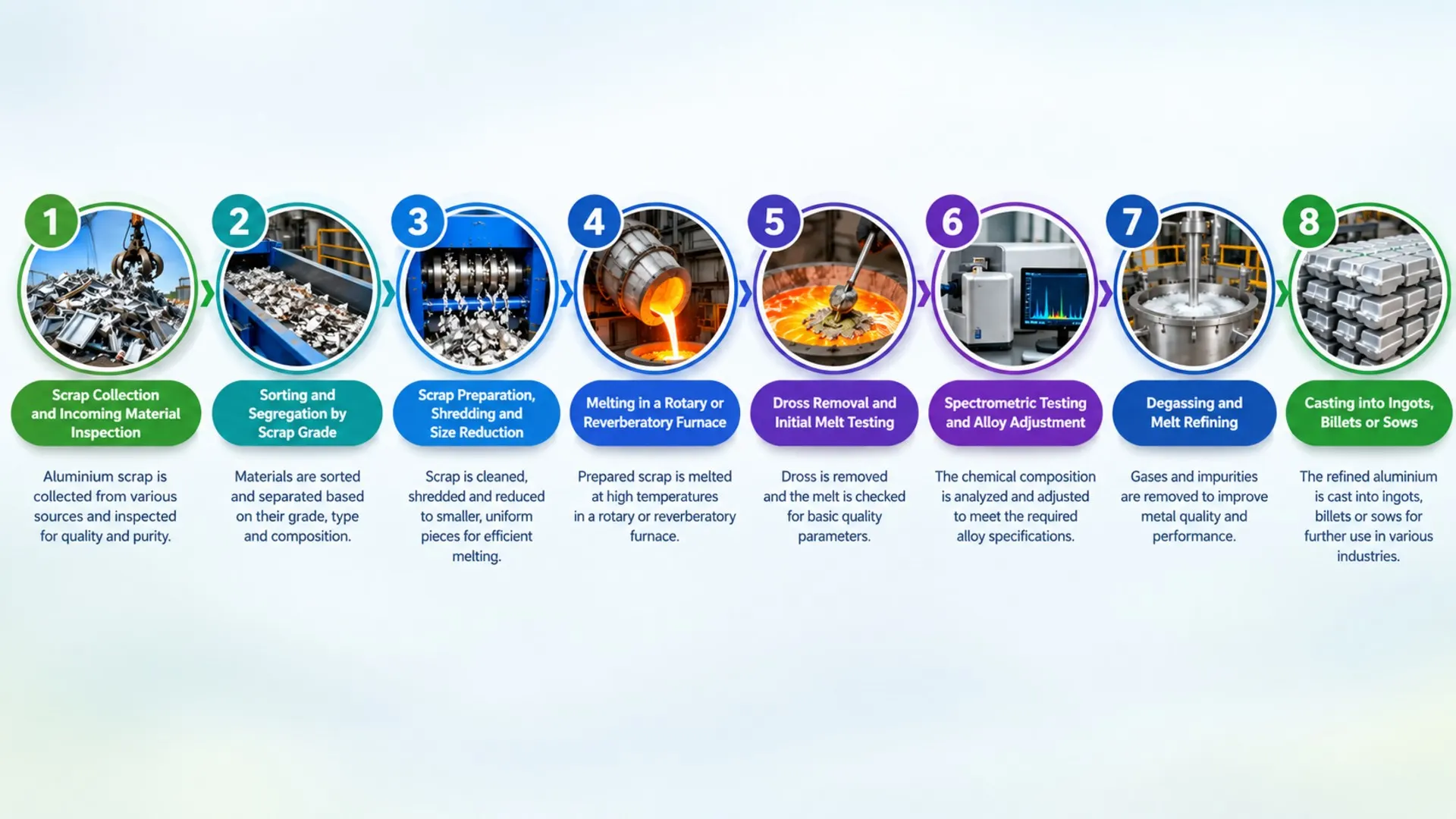
Recycling aluminium scrap into finished alloy ingots involves several carefully controlled stages. Each step helps recover metal efficiently, maintain alloy quality, and prepare the recycled aluminium for its intended application. Here is how the process works at a modern secondary aluminium recycling plant in India:
Stage 1: Scrap Collection and Incoming Material Inspection
Aluminium scrap comes from several sources, including direct purchases from automotive stamping plants, extrusion manufacturers and die casters. Recyclers also source material through organised scrap dealers and traders, municipal collection programmes, particularly for used beverage cans (UBC) and household scrap, and imports of pre-consumer process scrap.
When the scrap reaches the recycling plant, workers weigh and visually inspect it. The facility also takes a representative sample for preliminary chemical testing. A portable X-ray fluorescence (XRF) analyser helps identify the approximate alloy composition before the recycler accepts and prices the material.
Stage 2: Sorting and Segregation by Scrap Grade
Aluminium scrap does not have a uniform composition. Different alloy families, including 1000 series pure aluminium, 3000 series aluminium-manganese, 5000 series aluminium-magnesium, 6000 series aluminium-magnesium-silicon and high-silicon die casting alloys, have different properties and applications. These differences directly affect their value and suitable end use.
Experienced operators carry out manual sorting, while larger facilities may also use sensor-based systems such as XRF sorting conveyors and eddy current separators. Accurate segregation at this stage plays an important role in achieving the required quality and recovery rate in the final recycled alloy.
Stage 3: Scrap Preparation, Shredding and Size Reduction
Large and bulky scrap, such as vehicle components, extrusion offcuts and engineering parts, is cut or shredded into smaller pieces, often below 150 mm with the help of aluminium shredder machine. This makes the material easier to handle and increases its surface area, which supports more efficient melting.
Workers also remove contaminants such as steel inserts, plastic coatings, rubber and iron fasteners wherever possible. Plants may use thermal pre-treatment, such as decoating or delacquering, to remove organic coatings under controlled conditions. This process can recover energy from the coatings and reduce dross generation during melting.
Stage 4: Melting in a Rotary or Reverberatory Furnace
The prepared scrap then enters the melting furnace. Secondary aluminium recyclers in India commonly use two main furnace types.
Reverberatory furnaces: These furnaces are widely used for cleaner and well-sorted scrap. They work efficiently when processing large quantities of relatively uncontaminated aluminium.
Tilting rotary furnaces (TRF): These furnaces are better suited for mixed, painted or contaminated scrap. Operators add salt flux along with the scrap to collect oxides and non-metallic impurities in a molten slag layer. This allows the plant to recover a high percentage of metal even from challenging scrap streams.
The aluminium generally melts at around 700°C to 800°C. Chloride-based salt fluxes or proprietary flux compounds help limit oxidation, bring oxides and non-metallic impurities to the surface as dross, and separate contaminants from the molten aluminium.
Stage 5: Dross Removal and Initial Melt Testing
During melting, dross forms on the surface of the molten aluminium. Workers remove this material and send it for further recovery. Aluminium dross can contain around 30% to 70% metallic aluminium, which plants can recover through rotary salt furnace processing or mechanical pressing. Therefore, recyclers treat dross as a valuable by-product rather than simply discarding it.
The plant then takes a molten metal sample for analysis using an Optical Emission Spectrometer (OES). This test provides an accurate reading of the alloy composition and helps the metallurgist determine whether the melt meets the required specification.
Stage 6: Spectrometric Testing and Alloy Adjustment
The OES results are compared with the required alloy specification, such as ADC12, LM6, LM24 or a customer-specific grade. Based on the test results, the metallurgist adjusts the molten metal by adding the required materials.
These additions may include:
- Primary aluminium in ingot or wire form to reduce excessive alloying elements.
- Master alloys such as Al-Si, Al-Cu, Al-Mg and Al-Mn to increase specific elements to the required level.
- Pure alloying elements such as silicon, copper, magnesium, manganese and zinc for precise composition control.
This controlled alloy correction process separates a high-quality secondary aluminium producer from a basic remelter. It allows the recycler to consistently produce alloys that meet customer and international specifications.
Stage 7: Degassing and Melt Refining
Hydrogen dissolved in molten aluminium can create porosity in die castings and other finished products. After adjusting the alloy composition, the plant treats the melt using a rotary degassing system.
An impeller rotates inside the molten aluminium while an inert gas, usually nitrogen or argon, enters the melt. The gas bubbles travel through the molten metal, capture dissolved hydrogen and carry it out of the bath.
Plants may also use ceramic foam filters during the transfer of molten aluminium to the holding furnace or casting station. These filters help remove non-metallic inclusions and improve the cleanliness of the final metal.
Stage 8: Casting into Ingots, Billets or Sows
After refining and correcting the composition, the molten aluminium is cast into the required product form.
Common forms include:
- T-bar and sow ingots: Usually weighing around 5 kg to 22 kg and commonly supplied to die casting and foundry customers.
- Rolling ingots or slabs: Used by customers who process aluminium into sheets through hot rolling.
- Extrusion billets: Cylindrical products supplied to extrusion press manufacturers.
- Wire rod: Used for electrical wire and cable manufacturing.
The plant marks finished ingots with important information such as the heat number, alloy grade and weight. Workers then package the products in bundled stacks, generally on wooden pallets, for transportation.
Stage 9: Final Quality Inspection and Dispatch
Before dispatch, the recycling plant performs final quality checks on every heat of finished ingots. These checks include chemical analysis of cast samples, visual inspection for surface defects and verification of dimensions and weight.
The recycler also issues a Material Test Certificate (MTC) with each shipment. The certificate records details such as the alloy grade, chemical composition, heat number and relevant quality accreditation information of the producing facility.
Through these nine stages, aluminium scrap moves from collection and sorting to melting, refining, alloy correction and final casting. A well-controlled recycling process allows manufacturers to recover valuable aluminium while producing consistent secondary alloys for automotive, construction, electrical and other industrial applications.