
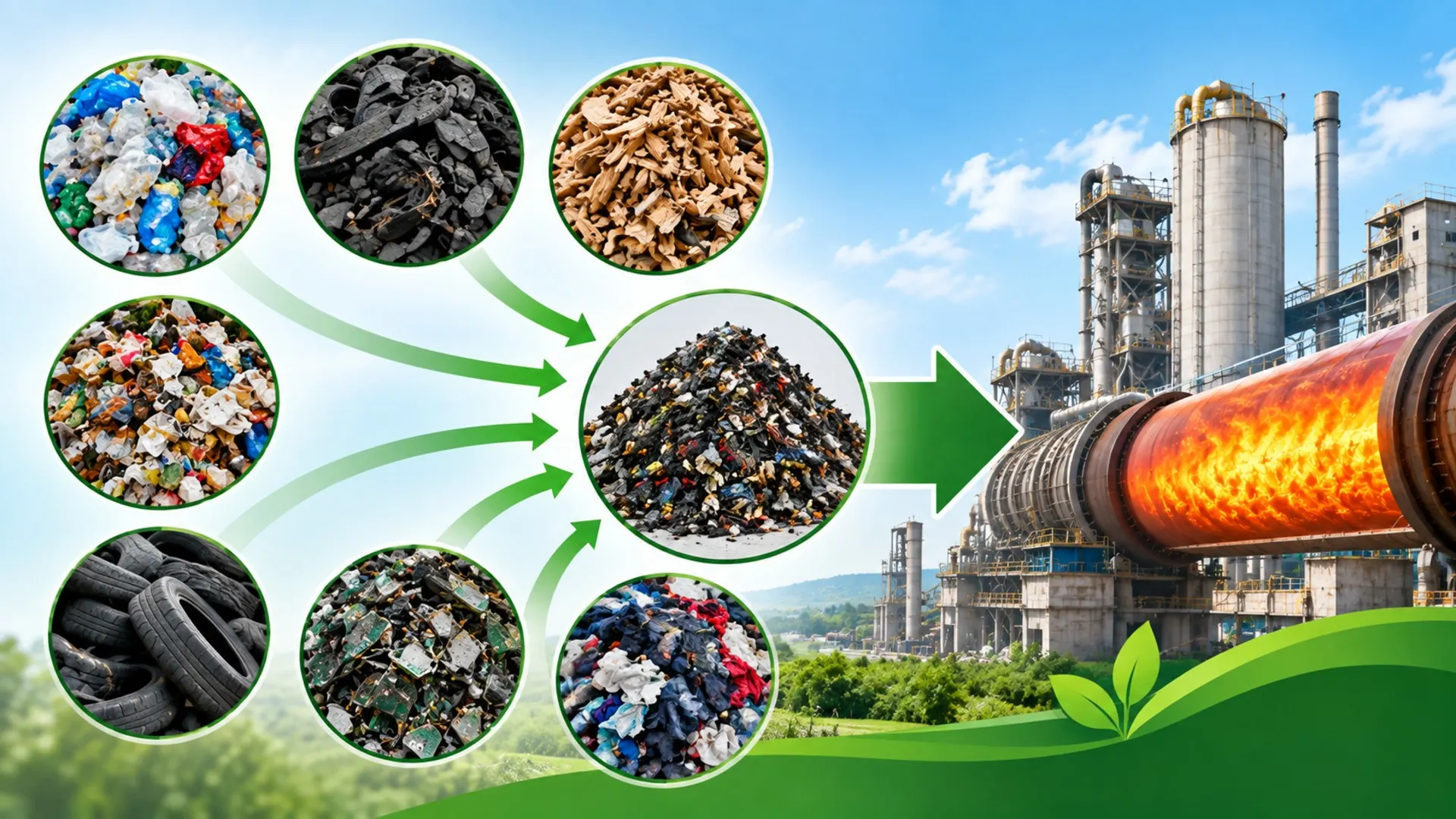
India’s cement industry is increasingly using Alternative Fuels and Raw Materials (AFR) to reduce dependence on conventional fossil fuels and improve waste utilisation. The opportunity is significant, but not every waste stream is suitable for direct use in a cement kiln.
The key question for a cement plant is not simply whether waste can burn. The real question is whether it can provide consistent thermal value, stable feeding, acceptable chemistry and reliable kiln performance.
This is particularly important as India looks to increase alternative fuel use in cement manufacturing. NITI Aayog’s Roadmap for Cement Sector Decarbonisation, published in January 2026, identifies a robust alternative fuel supply chain and greater use of refuse-derived fuel (RDF) as important pathways for reducing emissions from the cement sector. The roadmap also recognises the importance of waste processing and supply-chain development.
For cement plants evaluating AFR, RDF or SRF for co-processing, these seven parameters should be checked before the material reaches the kiln.
Calorific Value: How Much Energy Can the Waste Provide?
Calorific value (CV) is one of the first parameters cement plants examine because it indicates the amount of thermal energy available from the fuel.
Higher-CV materials such as selected plastics, waste tyres and properly processed RDF can provide significant energy. However, CV should never be considered in isolation. A material may show a reasonable CV in a laboratory test but still perform poorly if its moisture, ash or chemical composition varies significantly.
Under India’s Solid Waste Management Rules, non-recyclable waste with a calorific value of 1,500 kcal/kg or more is directed towards energy recovery rather than landfill disposal. This should not be interpreted as a universal minimum acceptance specification for every cement kiln. Actual AFR specifications are plant-specific and depend on the kiln system, feeding point, fuel mix and operating conditions.
The practical objective is therefore to produce a fuel with adequate and consistent calorific value, rather than simply chasing a high CV.
Moisture Content: How Much of the Fuel Is Water?
Moisture directly affects the usable energy of waste-derived fuel.
When wet waste enters the kiln system, part of the available thermal energy is consumed in evaporating the water. High moisture can also affect material flow, storage stability, feeding and the effective calorific value of the fuel.
This is especially relevant for municipal solid waste-derived RDF, where organic contamination and poor storage can increase moisture levels.
Cement industry guidance identifies moisture content as an important physical characteristic of alternative fuels. Depending on the feedstock, drying, segregation, weather protection and controlled storage may therefore be necessary before final AFR preparation.
For Indian waste streams, moisture control becomes even more important because waste characteristics can change significantly between seasons and locations.
Material Size: Can the AFR Be Fed Consistently?
A fuel with good calorific value can still create problems if it cannot be reliably conveyed and fed.
Oversized pieces may cause blockages, bridging or inconsistent dosing. Very fine material can create dust-handling challenges. The required material size also depends on where the AFR is introduced into the cement manufacturing process.
This is where shredding and size reduction become important.
Primary shredding can reduce bulky and irregular waste into a manageable size. Secondary shredding can provide tighter size control when the feeding system requires a more uniform fuel.
The objective is not simply to make waste smaller. It is to produce a consistent material size suitable for the plant’s storage, conveying and feeding system. Cement Manufacturers’ Association (India) aka CMA guidance also notes that some waste streams require shredding and removal of metals and stones before co-processing.
Ash and Inert Content: How Much Non-Combustible Material Is There?
Sand, stones, glass, soil and other inert materials add weight without contributing useful thermal energy.
High ash content can reduce the effective energy value of AFR and may also affect the material balance and clinker chemistry. This makes segregation and separation important steps in RDF and SRF preparation.
Cement kilns can recover the mineral fraction of some wastes, which is one of the advantages of co-processing. However, this does not mean that unlimited inert material is acceptable.
The quality of the final AFR must be evaluated against the cement plant’s specific process and raw meal requirements.
Chlorine, Sulphur and Other Chemical Parameters
AFR quality is not only about physical characteristics; chemical composition is equally important in the overall process.
Chlorine, sulphur, alkalis such as sodium and potassium, heavy metals and other trace elements can influence kiln operation, emissions, material circulation and clinker quality.
For example, excessive or highly variable chlorine can contribute to volatile cycles and operational problems. Sulphur and alkalis can also influence kiln chemistry and deposits.
CMA guidance recommends evaluating circulating elements such as Na, K, Cl and S, along with ash composition, heavy metals, toxicity, moisture, homogeneity and calorific value before selecting an alternative fuel.
This is why AFR acceptance should be based on laboratory testing and quality specifications, not simply on the visual appearance of the waste.
Homogeneity: Is the AFR Quality Consistent?
Consistency is one of the biggest challenges in using waste as an alternative fuel.
Municipal waste can contain plastics, textiles, paper, biomass, fines and inert material in different proportions. As a result, one batch may have a different CV, moisture level, ash content or chlorine concentration from the next.
For a cement plant, this variability can make kiln operation and AFR feeding more difficult.
A reliable AFR preparation system therefore needs to focus on sorting, separation, shredding, screening, blending and, where required, drying.
CMA specifically identifies density, homogeneity, moisture content, scrap size and other physical properties as important factors when evaluating alternative fuels.
The goal is to convert heterogeneous waste into a more uniform and predictable fuel stream.
Feeding and Handling: Can the Plant Actually Use It?
Even technically suitable AFR can become unsuitable if it cannot be handled reliably.
Bulk density, material shape, moisture, material-size distribution and flowability all influence how the material behaves during storage, conveying and dosing.
Therefore, cement plants should evaluate the complete AFR chain:
Waste reception → segregation → separation → shredding → screening → blending/drying → RDF/SRF preparation → storage → conveying → feeding → kiln/calciner
Different alternative fuels also require different preparation and feeding systems. CMA notes that alternative fuels can exist as liquids, gases, pulverised materials, coarse solids and lumpy materials, with different handling and dosing requirements.
Final Thoughts
For cement plants, the challenge is not simply finding waste that can burn but creating a reliable, consistent and kiln-compatible alternative fuel stream which can deliver predictable performance over time.
Achieving this requires more than a single processing step. Effective segregation, separation, shredding, screening, blending and quality control work together to convert heterogeneous waste into a more uniform RDF or SRF that can be handled, stored, conveyed and fed efficiently.
For cement manufacturers targeting higher Thermal Substitution Rates (TSR), investing in the right AFR preparation system can help turn variable waste quality into a more dependable fuel supply.
Fornnax supports cement plants with advanced shredding and AFR preparation solutions designed around feedstock characteristics, required fuel quality and plant capacity.
Ready to optimise your AFR preparation? Connect with the Fornnax team to explore the right solution for your waste stream and kiln requirements.